The core problem
Systems that don’t talk to each other.
Different organisations describe it differently, but the pattern is usually the same. Pick the one that sounds most like yours.
Disconnected systems
Your website or web application lives separately from the tools that actually run the work.
- Content, ticketing, CRM, ERP, stock, memberships or planning; all in different systems.
- Teams copy data manually between systems because nothing really connects.
- Reporting becomes unreliable because everyone works from different sources.
- Integrations exist, but only partially, or only one person still understands them.
We build platforms where the website or web application becomes part of the operational flow, not an isolated layer on top. We built this for BMW Loyalty, Moestik and Pukkelpop.



Generic CMS limitations
The CMS works fine for marketing pages, until operations get involved.
- Content structures no longer match how the organisation works internally.
- Editors need workarounds for multilingual content, permissions, workflows or reusable data.
- Every small change requires developer intervention.
- The system becomes harder to maintain with every new feature added.
We design digital platforms around the actual structure of the organisation, not around the limitations of a generic CMS or template. We built this for SAAMO Limburg and hetpaleis.


Scale and complexity
Growth introduced complexity the original setup was never built for.
- More content, more teams, more integrations, more edge cases.
- Internal processes became dependent on spreadsheets and manual checks.
- Performance, governance and maintainability start to matter more.
- The website quietly became business-critical.
We help organisations move from fragile setups to stable operational platforms. We built this for Dreamland and KULeuven.

Is this you?
A quick read on whether we’re the right fit.
- Your website or web application is part of daily operations, not just communication.
- You’ve outgrown a standard CMS or a custom setup that became painful.
- You need real integrations, not patched-together workarounds.
- Your team needs structure and workflows that actually fit reality.
- You’re looking for a long-term web development and platform partner, not only a launch.
Architect - our platform
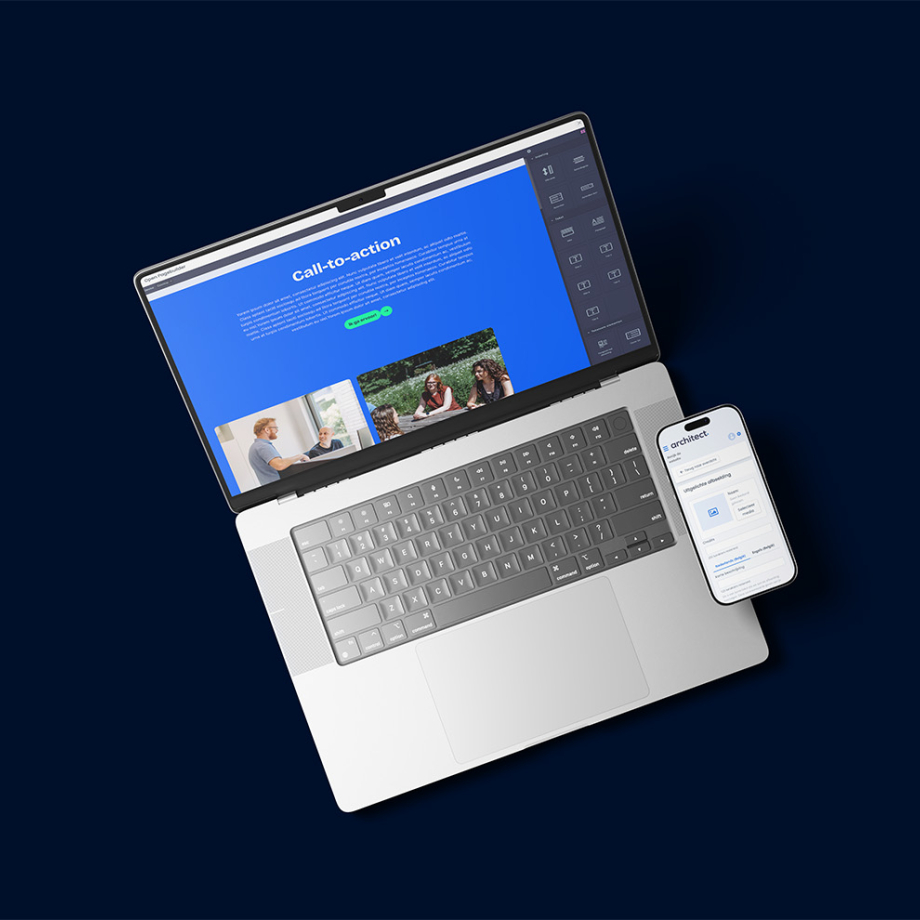
Most of this work runs on Architect.
The CMS we built for organisations where off-the-shelf ones can’t handle operations like these.
- Structure that matches operations
Content types, workflows and integrations modelled the way your organisation is actually shaped, not the way a generic CMS wants to model it. - Integrations wired in, not bolted on
CRM, ERP, ticketing, memberships, payments or planning systems connected in a maintainable way at the platform level, not patched at the edges. - Editorial autonomy
Teams can manage complex content structures without depending on developers for every update.
Same shape of problem, across very different organisations.
From Oudsbergen, Belgium, we work with organisations at home and abroad. The sector and location may differ. The operational complexity doesn’t.
Companies
B2B distribution, retail or specialty manufacturing business where the website isn’t marketing; it runs sales, stock and internal workflows. Operational websites and e-commerce platforms connected to CRM, ERP, inventory, planning or workflows.
Typical challenges
- Product and stock synchronisation
- CRM and ERP integrations
- Dealer or partner portals
- Multi-brand or multilingual structures
Culture & events
Festivals, music venues and cultural organisations where programming, ticketing and content need to work together. Often managed by small editorial teams working live under constant time pressure.
Typical challenges
- Complex programme structures
- Venue and event management
- Planning and ticketing integrations
- High traffic moments
Public & institutional
Healthcare organisations, educational institutions and public organisations where content has to remain reliable, structured and maintainable over many years, while editorial teams need autonomy without depending on developers for every change. Platforms with governance, accessibility, permissions and structured information requirements.
Typical challenges
- Large content ecosystems
- Multiple departments or editors
- Accessibility requirements
- Long-term maintainability and governance
Tell us what you’re working on.
We can help assess where the actual bottlenecks are, and whether we’re the right fit to solve them.